zaterdag 16 februari 2013

BOTT XR1


Beautiful motorcycle based on the Buell XB12 from Bottpower.


Buell XB12SS Lightning


Buell XB12SS Lightning Long
Twinmotorcycles reprogrammed ECM
K&N Airfilter
Torque Hammer exhaust
Big header
TITAX brake and clutch lever
2010 Buell LED rear tail light
Kellermann indicators


Same bike with Hero blue airbox cover and flyscreen


woensdag 13 februari 2013

Motorcycle Garage

There is something universal that we feel in old garages.

When I speak about garages, I speak about the real ones, not the corporate bike Dealers, those where you can breath the mechanics first, and smell this mixture of oil, gas, metal that takes you up to the nose after crossing the door.


If you have any beautiful pictures of motorcycle garages please send them to me:  p.dreesen@ziggo.nl


zaterdag 1 december 2012

LAVERDA 1200 MIRAGE


I just bought a Laverda 1200 which was originally a Blue 1200 Sport from 1979.
It has been restored a 15 years ago and was than painted black and gold as the 30th anniversary model at the time it had done 32000 kilometres.
It has been standing in a shed for the last 12 years and has done 363381kilometers.

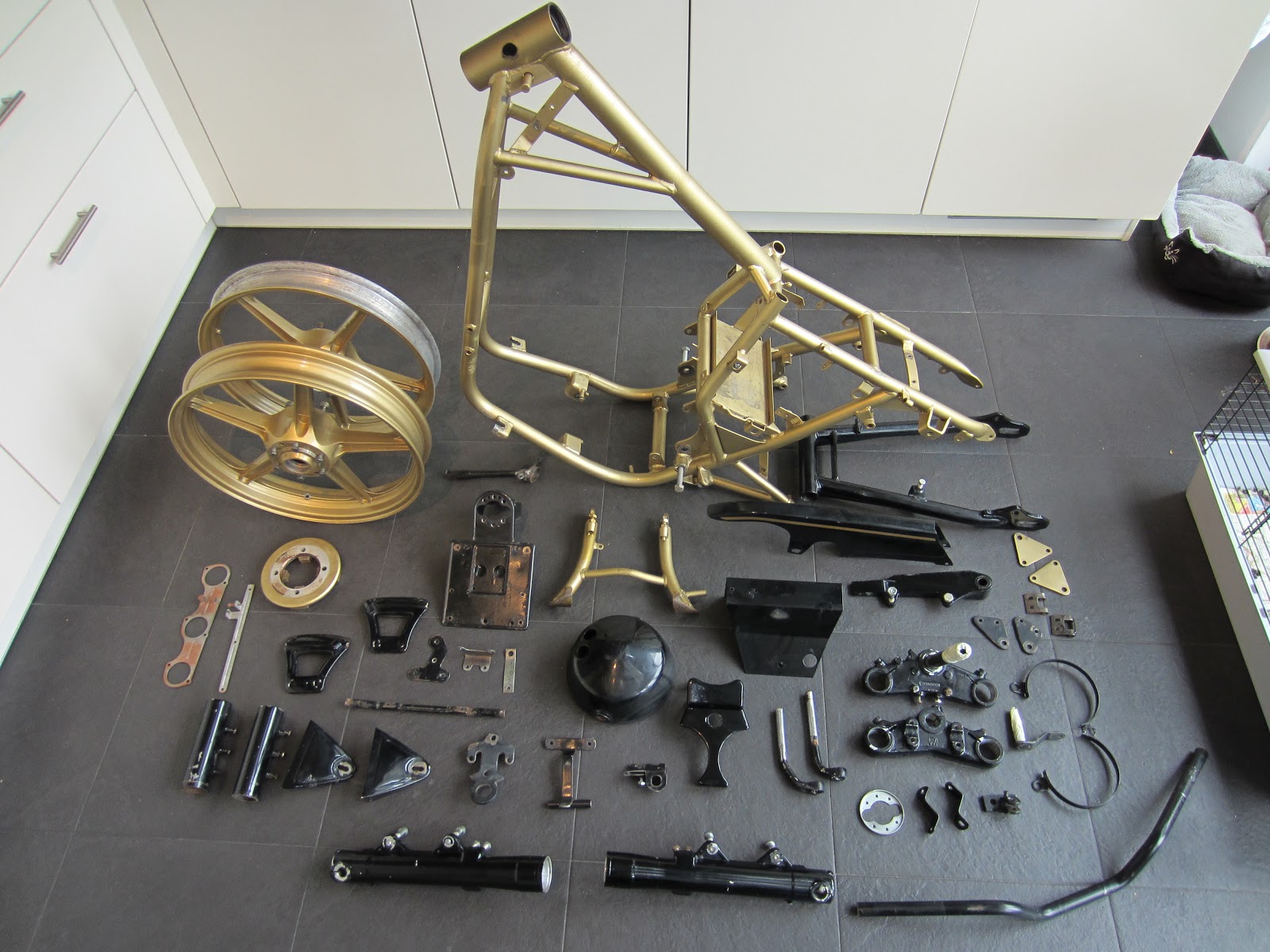
Brought it home and after a good inspection decided it needed a complete restoration. Standing in a shed for the last 12 years did the bike no good.
Dismantled the bike in one weekend and started to build the bike from the ground up.
This is going to be a Laverda Mirage like the one the Slater brothers build for the British market.
Laverda's legendary Jota was a British creation. Slater Brothers, the UK importers of the day, added the heat. A few years later they did the same thing again with the factory's new 1200, turning the big soft tourer into a much more potent missile.
The Jota might have been the most famous of the Seventies laverdas, but the Mirage was in many ways the best of the bunch. Like the Jota, it was essentially a tuned-up version of the Breganze factory's standard triple. Slater Brothers, the British Laverda importers of the day, created the Jota by uprating the standard 3Cl triple with high compression-pistons, endurance race cams and aloud pipe, lifting the power output to 90bhp and producing a mighty machine that was a match for anything on the road or production-race track.
In 1978, when Laverda bored out the dohc three cylinder lump to 1116cc and fitted flat handlebars and a larger dual-seat to produce the softer, more practical model they imaginatively called the 1200, Slaters struck again. With no production racing plans this time they left the compression ratio at the standard 8:1, but added the endurance race camshafts and the Jota exhaust system, increasing performance considerably.
The Mirage was born.
"The 1200 was a soft and woolly tourer to start with, but the cams and pipes really transformed it," recalls Richard Slater, who still runs the business today although brother Roger has lived in America for many  years. One of our dealers came up with the name Mirage. Laverda also used the name for other markets, but without the tuning bits they manufactured badges and did a bit of a marketing job on it. 


13 dec. 2013 1 Year later, had some problems with the fenders...
Finally got them back
Now I have to start working on the electrical system.


Also see my other weblog: Laverda restauration.

zaterdag 6 oktober 2012

Laverda 1000 Endurance Racer

Bol d'Or 1972 Laverda 3CL 1000 Endurance Racer -Team Slater


Bol d'Or 1972 Laverda 1000 Endurance Racer


Laverda 1000 Endurace Racer Replica


1972 Laverda 1000 CL 180⁰ Tripple

Jota pistons
4C Cams
K&N air filters
Front and rear Brembo brakes from a Ducati 996
Stainless steel braided brake line hoses
Front fork Marzocchi 38 mm
Progressive front suspension
Fork stabilizer
KONI rear suspension
Brembo hydraulic clutch conversion
Cibie headlights
3 in 1 Race exhaust (40mm exhaust down pipes)
Tommaselli clipons
Jota rear brake and shift set
Matching frame and engine number
Oil catch can


The 3C commenced production late in 1972 with the 2LS Laverda drum brakes front and rear (eeek!), 35mm Ceriani forks (EEEK!!), a twin cradle frame and lovely big 200mm headlight.  Very quickly the forks were upgraded to somewhat more appropriate 38mm items. 
In 1974 model year the triple was upgraded to twin Brembo disc brakes at the front, and some way through the year saw the appearance of the oil cooler.  The performance of these bikes was pretty awesome by the standards of the time, however there is no such thing as 'too much horsepower' and as such, the Slater brothers in England started selling the 3CE (E for England) in 1975.  It was basically a 3C with single seat and modified exhaust system for improved flow, the collector box was larger and the pipes had larger outlets and less (or no) baffling.  It boosted the top end power by some 8hp and made it the first production bike to crack the 140mph mark- exciting stuff!  As previously mentioned vibration was an issue at higher revs and the bike was big and heavy - though no more so than similar bikes of the period - and pretty tall in the saddle.  They established a fearsome reputation!

Nineteen seventy six marked the first major revision of the triple with the emergence of the 3CL with it's cast five spoke wheels, side-hinged seat and plastic ducktail.  The new wheels carried two discs at the front and one on the rear, all 280mm Brembos gripped by the same companies twin piston calipers.  This machine formed the basis for the legendary Jota, a machine which attained cult status in the UK.  The original Jotas were once again built in the UK by Slaters and now featured 4C cams and high compression pistons, borrowed from the factory endurance racers, lurking within.  These combined with the large-bore collector box and virtually straight-through 'mufflers' (the name hardly seems apt!) to produce performance ahead of anything available at the time.  Much of the mystical reverence toward Laverdas by other motorcyclists even to this day is based on the reputation this bike developed in the late 70's.  The name Jota comes from a Spanish dance in 3-4 time and was coined by Roger Slater.

These early Jotas were not made in the factory, but were rather 3CL's converted by Slaters with the aforementioned hot up bits. Technically, these were for the UK market only, but a number were exported.  

1978 1200In 1977 a new larger version of the triple was developed - the 1200. The name was something of a gross exaggeration - the actual capacity being 1116cc - but it sounded good for the marketing! The 1200 was not terribly far removed from the 1000, the main difference being a slightly different upper crankcase and barrel to allow for the capacity, and slightly different tank and sidecovers. For whatever reason, the 1200 did not really catch on, developing (without reason in the author's opinion) a reputation for being somewhat more rough. In reality the 1200 is a gem of an engine, more torquey and when set up correctly just as smooth as the 1000.
By 1979 the factory assumed production of Jotas, which were now in the classic orange and silver livery and are immediately recognisable by the laid-forward rear shocks and Marzocchi suspension, these were sold alongside the similarly upgraded 3CL.  Around this time some ill-considered technical changes were made to crankshaft bearings, head design, and valve springs which caused Laverda no end of grief throughout 1979 and 80. The financial impact of the repairs (when performed) was significant, but the damage to the reputation was also a major blow. The 1980 Jota gained a frame mounted fairing - not the greatest styling success of all time - but few other changes.

1981 saw the first significant re-engineering of the engine with the emergence of the 'Mark II' 180.  The ignition pickups were moved to the left hand side of the crankshaft and a Nippondenso alternator was fitted to the right.  Not only did this change even up the lumpy early motor with its large alternator on the right side, it also addressed the poor charging rate of the early Bosch alternators.  Changes were made to the crankcase and primary cover in readiness for a left-foot gear change but for the moment the familiar right-side mechanism remained, although operated now via a hydraulic clutch which somewhat improved the heavy clutch pull.  The fairing was new and in my opinion a huge improvement over the 1980 version, though some dislike it.  This represented the end of the line for the 180 motors, they were no longer at the forefront of performance but remained highly respected and capable road-burners.

More Endurance Racers.........


You can also have a look at my Laverda Blog Click HERE